Florence · Palace and museum
Inside Palazzo Vecchio: the passages the standard route skips
Palazzo Vecchio looks like a fortress but still works as Florence's town hall: the mayor has had an office here since 1872. The ticket you can book on this page is the guided secret passages visit, and it helps to know exactly what that is before you buy.

A palace that has changed its name several times
Work began in 1299 on the ruins of buildings that belonged to the Ghibelline Uberti family, and the design is credited to Arnolfo di Cambio, who also did the cathedral and Santa Croce. It started as Palazzo dei Priori, became the Palazzo della Signoria, and was called the Ducal Palace once Cosimo I de' Medici moved in during 1540. It only became the Old Palace after the court moved across the river to the Pitti. The square kept the Signoria name, which explains the mix of labels on signs.
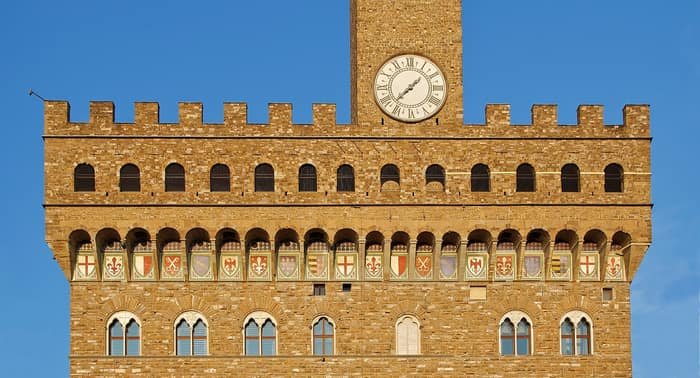
Look at the tower from the square: it is off-centre because Arnolfo built it on top of an earlier tower. It stands 94 metres high and holds two small cells where Cosimo the Elder was held in 1433 and Savonarola in 1498. From 1865 to 1871, when Florence was the provisional capital of the kingdom, Italy's parliament sat here.
What the secret passages visit is, and is not
There are two very different ways into the palace. One is the museum of the big state rooms, at your own pace. The other, the one you book here, is a guided visit at a fixed time through service and passage areas: narrow staircases, corridors and small rooms behind or above the showpiece halls. Exactly what each departure covers can vary, so the booking description has the final word.
Expect tight corridors, a low ceiling here and there, and a lot of explanation about how rulers and their servants actually moved around. Do not expect a quick pass through the main rooms. The Hall of the Five Hundred, with Vasari's frescoes covering the walls that Leonardo and Michelangelo never finished, belongs to the palace but is not the reason for this ticket, so check on the booking page whether the visit goes through it.
Before you go in: the door and the first courtyard
At the door stands a copy of Michelangelo's David, put there in 1910; the original stood here until 1873 and now lives in the Accademia Gallery. It is flanked by Bandinelli's Hercules and Cacus. The two statues were commissioned under different regimes, the republic and the Medici, and read like a small political argument in stone.
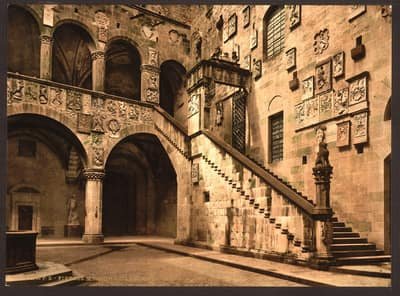
Inside, the first courtyard is by Michelozzo. Its walls carry painted views of Habsburg cities, among them Vienna, Prague and Innsbruck, which Vasari painted in 1565 for a Medici wedding. The putto with a dolphin on the fountain is a copy; Verrocchio's original is kept upstairs. The fountain's water used to arrive through pipes from the Boboli Gardens.
Basement, tower and museum: three things people mix up
Beneath the palace lie remains of Roman Florentia: the theatre once stood on this spot. Excavations began around 2000 and several rooms opened to the public in 2008. That is a separate visit from the secret passages, so do not assume that one ticket covers the other.
The same goes for climbing the tower and for the museum of the state rooms: they are separate options. Before you pay, read the exact ticket name and what it includes. On a short trip this visit pairs well with the Uffizi, right next door, and with a two-day plan for Florence.
Tips before you go
- Arrive with time in hand. The guided visit leaves at its set time. Security and finding the meeting point can eat a few minutes, so do not cut it fine.
- Shoes and bag. There are narrow stairs and tight passages. Comfortable shoes and a small bag make the route a lot easier.
- Read the ticket name. The palace sells museum, tower, underground and passages tickets. The one booked on this page is the guided secret passages visit.
- Pair it with the Uffizi. They are a few steps apart. Vasari built the corridor linking the palace to the Uffizi and on to the Pitti, so both fit into the same morning.
- Book ahead in high season. Guided visits have a limited number of places per slot. Prices and availability are shown on the booking site, Weekend in Italy.
- Give the square a minute. Before or after, look at the one-handed clock on the tower and the copies at the door. They are details the interior will not explain.

Frequently asked questions
What does the ticket you book here include?
It is the guided visit through the secret passages of Palazzo Vecchio. The detail of what each departure covers is on the booking page.
Is it the same as the palace museum?
No. The museum is the self-paced route through the state rooms; the secret passages visit is guided, in a group, and goes through areas the usual route does not.
Does it go through the Hall of the Five Hundred?
It depends on the visit. Check the description on the booking page before buying if that hall is your priority.
Do I need to book in advance?
It is wise, especially in high season: guided visits run by time slot with limited places.
Is it suitable for children?
It tends to work for kids who can manage stairs and listening to a guide. Check the booking page for any minimum age or conditions.
Affiliate link: if you book, this site may receive a commission.