Florence · Sculpture museum
The Bargello: a former police headquarters full of Donatello and Michelangelo
The Bargello was a magistrates' seat, a police station and a prison, and today it holds the best collection of Florentine Renaissance sculpture. Plenty of first-time visitors skip it on a trip to Florence because the Uffizi and the David soak up the attention, which is a planning mistake: here you can see Donatello and Michelangelo with less crowding, in a medieval building that is worth the visit by itself.

A palace that became a prison
Construction began in 1255 to house the Capitano del Popolo and, from 1261, the podesta, the highest magistrate of the city council. It is the oldest public building in Florence and served as the model for Palazzo Vecchio. In 1574 the Medici abolished the role of podesta and installed the bargello, the chief of police, here, hence the name. It was later a prison; executions took place in the courtyard until 1786, and the Florentine police stayed on until 1859.
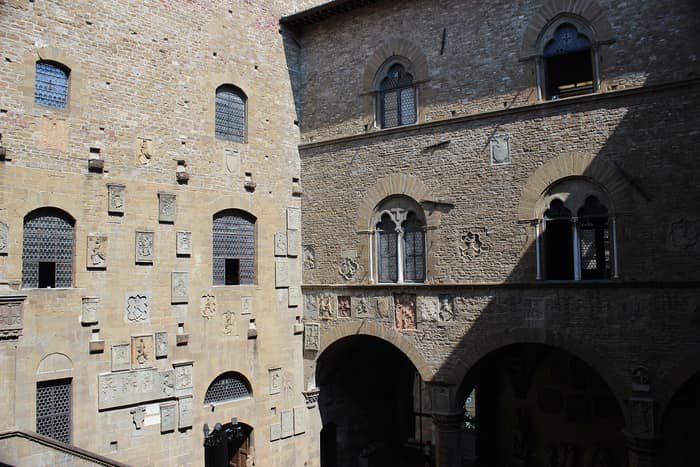
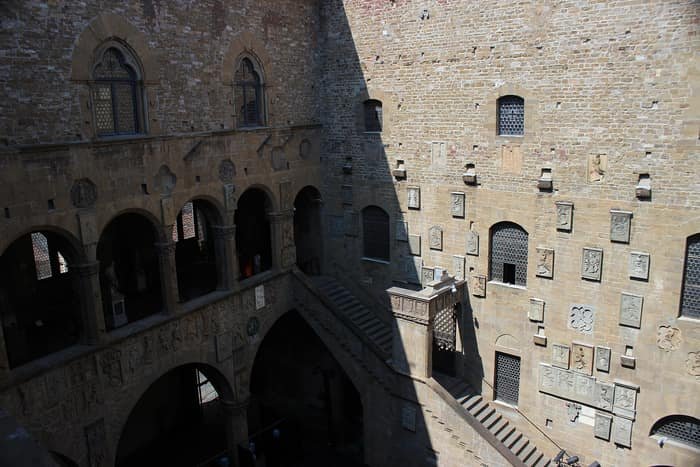
The word bargello was originally the title of a captain in charge of keeping the peace, who in Florence was usually hired from another city to avoid any suspicion of favouritism. It was restored between 1858 and 1865 and has been a national museum since 1865. The courtyard, dating from 1280 to 1285, with its external staircase and open well, is the best way in: austere, crenellated and lined with reliefs and coats of arms.
Donatello, Michelangelo and a pair of Davids
The best-known pieces are Michelangelo's Bacchus, Pitti Tondo, Brutus and David-Apollo, and Donatello's two Davids, one in bronze and one in marble, plus his Saint George with its relief, the Marzocco and the Amore-Attis. Having Donatello's and Verrocchio's Davids in the same museum lets you compare them with the one at the Accademia Gallery, which is much bigger and quite different in character.
Do not miss the room with the panels submitted for the 1401 competition for the Baptistery doors: the winning one by Ghiberti and the runner-up by Brunelleschi. And among the later work, Bernini's bust of Costanza Bonarelli and Giambologna's Mercury, from the end of the Renaissance.
What is not sculpture
There are also maiolica ceramics, tapestries, ivories, medals, armour and coins; the collections of nielli and of Italian Renaissance medals are of international importance. Among the more curious pieces is the right-hand panel of the Anglo-Saxon Franks Casket, carved in bone. There is also an Islamic hall, and paintings including cassoni, the wedding chests, and painted birthing trays.
And the Magdalen Chapel, in the medieval building, with extensive but damaged frescoes attributed to Giotto, including a full-length portrait of Dante.
Where it fits in your Florence day
There are generally fewer queues here than at the Uffizi, which makes it a good plan for the part of the day when you no longer want to fight for space. Some of the Uffizi's most famous statues were moved to the Bargello in the past, so one museum completes the other. Tickets are booked on an external site, Weekend in Italy, where you can see prices, availability and conditions. The Bargello belongs to a group of museums that includes the Medici Chapels.
Tips before you go
- Start in the courtyard. Before heading into the rooms, give a minute to the courtyard and the external staircase. It is the most medieval part of the complex.
- Prioritise the main rooms. If you tire, let it be after the Davids and Saint George, not before. The best sculpture is in the main rooms.
- Compare the two Davids. Donatello's (here) and Michelangelo's (at the Accademia) belong to different eras and different approaches. Seeing them on the same day makes the differences obvious.
- If you only have an hour. The courtyard, the Donatello and Michelangelo sculptures, and the 1401 competition reliefs. Leave the decorative arts for another trip.
- Look closely at the small objects. Medals and nielli reward a close look and take time to read. Two minutes in front of a showcase is enough to appreciate them.
- Pair it with Piazza della Signoria. You are a few minutes from the square, so a short walk before or after fits without effort.
- Check the opening days. The calendar can vary. Check the booking page before choosing your day.
Frequently asked questions
Why is it called the Bargello?
Because from 1574 it housed the bargello, Florence's chief of police. Before that it was known as the Palazzo del Podesta.
How long do you need?
One and a half to two hours. One hour is enough for the main pieces.
Which Michelangelo sculptures are there?
Bacchus, the Pitti Tondo, Brutus and David-Apollo, among others.
Are there long queues?
Generally fewer than at the Uffizi, though it depends on the day and the season.
Is there important painting?
There are some paintings, but it is not the main collection. For Florentine painting, the Uffizi is better.
Affiliate link: if you book, this site may receive a commission.