Venice · Palace and museum
Ca' d'Oro: the Gothic palace that lost its gold and gained a museum
Ca' d'Oro answers a question almost everyone asks from the vaporetto: what is that lace-like stone palace on the Grand Canal? There is no gold left on the facade today, but it is one of the best surviving examples of Venetian Gothic, and inside is an art gallery that is modest in size and pleasant to walk through.

Where is the gold?
That is the first practical question. The name refers to the gilded and polychrome decoration that once covered the facade, but the gold is no longer on view. In 1431 the painter Zoane di Franza added gilding to the building, alongside white Istrian stone treated with white lead and oil to give it a marble sheen, and details in red Verona stone. What remains is the geometry: pointed arches, openwork tracery and pinnacle-like finials whose balls were once covered in gold leaf.
The palace, also known as Palazzo Santa Sofia, was commissioned by Marino Contarini, from a family that had given Venice eight doges. In the 15th century it was a way of asserting his house's standing, and it was built near Rialto, on the busiest stretch of the Grand Canal. Giovanni Bon and his son Bartolomeo built it, with the Milanese Matteo Raverti, who is credited with the tracery of the main loggia and the ogee arch over the land entrance.
A facade that is lopsided on purpose
The lack of symmetry is not a conservation flaw. The asymmetrical layout let light into rooms where side windows were impractical because neighbouring buildings stood so close. The facade is organised in three levels: a low loggia, a middle balcony and an upper one, each more ornate than the last. Look at it for a few minutes and you see why it became a reference point for Venetian Gothic.
The interior follows the logic of a merchant house. A large hall, the androne, opens onto the canal and was used to receive and dispatch goods, while the main reception hall, the gran salone, sits on the piano nobile, the noble floor, directly above. The upper floors were family living quarters. A wellhead and a small garden remain in the inner courtyard. Walking through the building is also a lesson in how a well-off Venetian family lived.
From private palace to Franchetti museum
Baron Giorgio Franchetti bought the palace in 1894 and restored it thoroughly; he donated it to the Italian state in 1916, and in 1927 it became a museum. Hence the official name, Galleria Giorgio Franchetti alla Ca' d'Oro. Do not confuse it with Palazzo Cavalli-Franchetti, which shares the surname but is a different building.
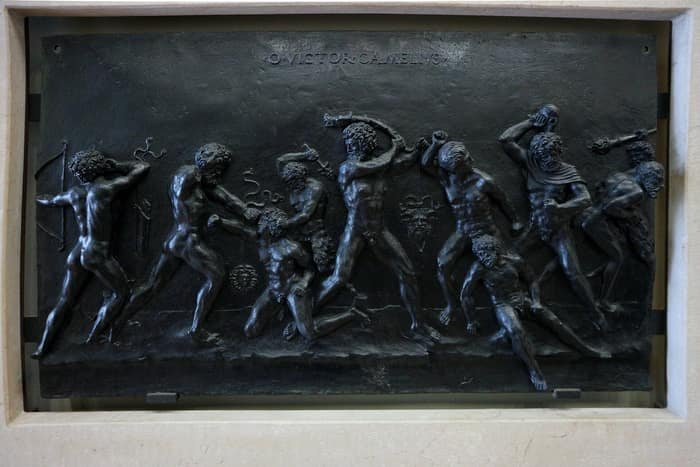
Among the works it holds are Andrea Mantegna's Saint Sebastian, several views of Venice by Francesco Guardi and part of the frescoes from the Fondaco dei Tedeschi, on which Titian and Giorgione worked. It is not a museum of enormous halls, and that works in its favour: you can see it in a long hour, and the building itself is half of what you will be looking at.
Combining it with the rest of Venice
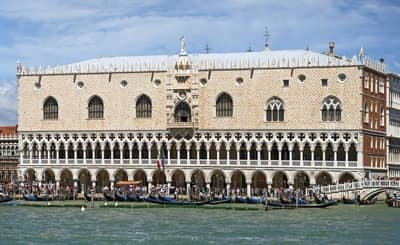
Ca' d'Oro sits across the water from the Gallerie dell'Accademia, so walking between them makes little sense: give each side of the canal its own day. If you are in Cannaregio, you can carry on to Rialto in a few minutes and, later, to the Doge's Palace, whose loggia served as the model for this facade. The one-day Venice itinerary helps you fit everything into a single day.
Tickets are booked on an external site, Weekend in Italy, where prices and availability are shown by date.
Tips before you go
- Look from outside first. The facade makes more sense from a vaporetto or from the opposite bank than from inside. Give it a couple of minutes before going in.
- Go up to the canal loggia. The views of the Grand Canal from the balconies are worth the time on their own. It is the best place to take photos without the rush of the street.
- Book before you go. A booked ticket lets you pick the day and avoids deciding at the door. Prices and availability are shown on the booking page.
- Do not mix up the Franchetti palaces. Another palace with that surname stands on the Grand Canal. Use the full name: Galleria Franchetti alla Ca' d'Oro.
- Plan for the neighbourhood. Cannaregio is best on foot. If you add the neighbourhood, plan a morning rather than a quick stop.
- Check the weekly closing day. As in other Italian state museums, there is usually a closing day or reduced hours. Confirm when you book.
- Notice the details. The most surprising features are not at eye level: look at the capitals, the tracery and what is left of the original decoration.
Frequently asked questions
Why is it called Ca' d'Oro?
After the gilding and polychrome decoration that adorned the facade, now gone. The name means House of Gold.
How much time do you need?
Between one hour and an hour and a half, including the views from the loggia.
What is inside?
A gallery with Mantegna's Saint Sebastian, views of Venice by Guardi and fragments of the Fondaco dei Tedeschi frescoes.
How do you get there?
By vaporetto to the Ca' d'Oro stop, or on foot from the Rialto Bridge, in Cannaregio.
Where do you buy tickets?
They are booked on an external site, where prices and availability are shown by date.
Affiliate link: if you book, this site may receive a commission.