Siena · Medieval city
Siena step by step: the square, the cathedral and the museums
Siena fits into an afternoon if all you want is the square, but it pays off with a night. This guide suggests a sensible order, flags where the bottlenecks form (the cathedral and the tower) and tells you which tickets are worth sorting out before you head up the hill.

Start at the Campo and let the city slope toward you
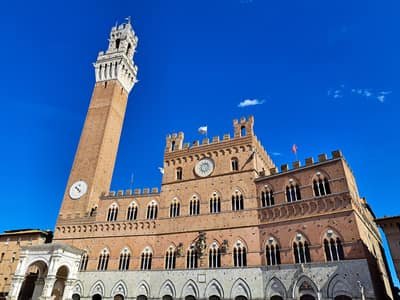
Everything in Siena is organised around Piazza del Campo, a shell-shaped square that tilts down toward the Palazzo Pubblico. There is nothing to buy to enjoy it: people sit on the ground, look at the tower and do very little. Pass through twice, once in the morning while the city wakes up and again at dusk, when the brick changes colour.
Twice a year, in summer, the square is covered in dirt for the Palio, the horse race between the contrade, the neighbourhoods that divide the city. If your dates overlap, life in the centre revolves around it and finding a room means booking well ahead. If not, you will still see each district's flags hanging in the streets and the rivalry is easy to sense.
The Palazzo Pubblico: the museum that explains why Siena was rich
The medieval town hall houses the Civic Museum of Siena, and the highlight is the Sala dei Nove, where Ambrogio Lorenzetti painted the Allegory of Good and Bad Government in the 1330s. It is political painting with a city and countryside in plain view: you understand it without knowing art history, and it shows how a republic of merchants and bankers saw itself. Give yourself time to stand in front of it rather than walk through.
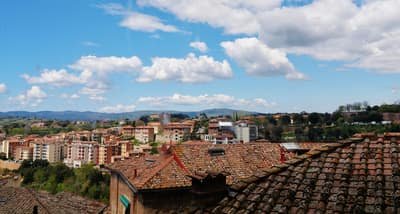
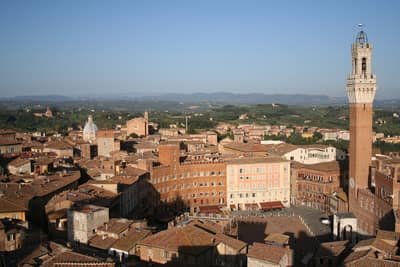
The Torre del Mangia next to the palace is climbed by a narrow staircase and access is usually regulated. It is a tiring ascent, not ideal in extreme heat; the reward is a clean view over the roofs and the hills.
The Duomo, between striped marble and a building that never got finished
The Siena Cathedral is recognisable from a distance by its bands of pale and dark marble. Inside, the floor is a sequence of scenes inlaid in marble that, because it is fragile, is not always uncovered; check before you go if you want to see all of it. The Piccolomini Library, with its vividly coloured frescoes, is the room that surprises most.
A detail few visitors know: what you see is not the cathedral that was planned. The Black Death of 1348 halted work and left the enlargement unfinished; a huge empty wall still stands and is easily mistaken for another facade. Opposite is Santa Maria della Scala, a former pilgrims' hospital turned museum, with frescoed halls and underground spaces. It suits anyone who needs a cool pause away from the crowds.
How long to give Siena
With one day you can see the square, the Palazzo Pubblico and the cathedral without rushing, and still have time for a plate of pici and a slice of panforte. Add Santa Maria della Scala and some wandering through the districts and the afternoon is gone. With a night, the city changes: once the day-trip groups leave, the centre goes back to the locals.
Many visitors combine Siena with San Gimignano in one day from Florence. It can be done, but it ends in a hurry and with tired legs; if you only have a day, stay in Siena or check the one-day itinerary for Siena and San Gimignano to see how to split the hours.
Tickets: what is worth booking ahead
The practical rule is to book what runs on time slots or limited places and leave the rest open. First sort out the cathedral complex: entry to the Duomo is usually tied to a pass that bundles other monuments of the group, and climbs to the upper areas are offered at fixed times with small quotas. Check what each option includes before choosing, because the names are similar and not every ticket covers the same things.
The Civic Museum and Santa Maria della Scala are usually easier to improvise, but in high season it helps to arrive with a ticket already bought. Tickets are booked on an external site, Weekend in Italy, where you can see prices, languages and live availability.

Tips before you go
- Arrive low, climb slowly. The station is far from the centre and uphill. Treat the route to the square as part of the visit, not an errand.
- Plan the day around shade. The square and the Duomo are best early. Leave museums for midday, when the sun is at its worst.
- Book the tower first. Climbing slots run out before everything else. If you want to go up, make it the first thing you reserve.
- You do not need to enter everything. The cathedral, the Palazzo Pubblico and a walk through the streets cover the essentials. The rest is optional.
- Look down in the Duomo. If the floor is uncovered, take a few minutes to walk it slowly; it is part of the visit, not decoration.
- Eat away from the Campo. Terraces on the square cost more than they deliver. Two streets uphill the food is better and quieter.
- A pass only if you will use it. Before buying a multi-monument pass, count how many sites you will really enter.

Frequently asked questions
Can you see Siena in one day?
Yes: the square, the Palazzo Pubblico and the cathedral fit well. If you add Santa Maria della Scala and want to wander, staying a night is more comfortable.
Do you need to book the cathedral in advance?
In high season it helps, especially for the climbs to the upper areas, which run on time slots.
Is it better to come by train or bus from Florence?
Both work. The bus usually drops you closer to the historic centre; compare routes and times for your day.
When is the Palio?
It is run twice a year, in summer. Check exact dates on the municipal website before you plan around it.
Can you combine Siena with San Gimignano?
Yes, on a long day with a car or an organised tour, but you will see each place in a hurry.
Affiliate link: if you book, this site may receive a commission.